

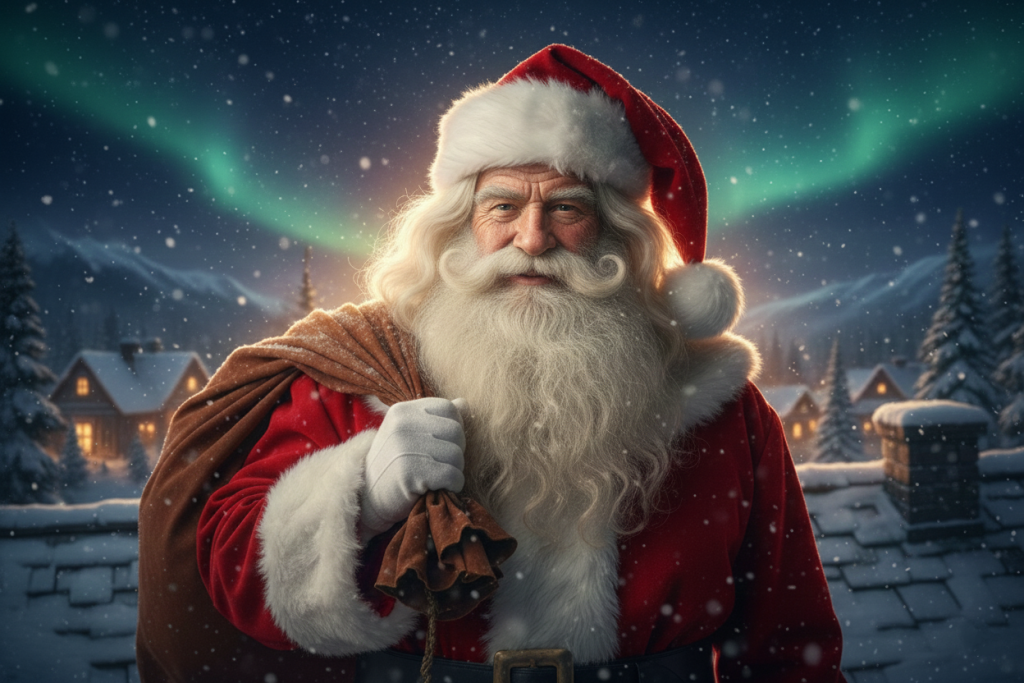
A spokes-elf for the North Pole has confirmed that Santa will once again make his customary Christmas Eve journey, delivering presents to good children across the globe. Rumours had begun to swirl that Christmas might be in jeopardy after an unusual spike in activity was detected in Santa’s private den. Head Elves from every department were summoned to emergency meetings, and an insider, speaking under strict anonymity, hinted that something significant was happening.
According to this source, Elliot Grimshaw, the billionaire mogul behind the world’s largest online retailer, had allegedly set his sights on undermining Santa by offering toys and electronics at extremely low prices under the provocative tagline: “Why wait ’til Christmas?” Instant gratification has become a modern scourge, affecting children and adults alike. Santa’s leadership team feared that Grimshaw was attempting to invade Santa’s domain for profit. But when the elves ran the numbers, the situation appeared even stranger. Grimshaw was selling below cost and losing enormous amounts of money.
Santa and his advisors were baffled. What could possibly motivate such a self-sabotaging campaign?
Seeking answers, Santa turned to the Head of Letters, whose vast archive at the edge of Santa’s Village contains every letter ever written to him. She was instructed to compile a full profile of Elliot’s childhood correspondence. Most children write faithfully each year until adolescence. Elliot’s pattern was slightly unusual: he wrote consistently from ages 3 to 10, skipped one year, and then sent a final letter at age 12.
It was that last letter that provided the breakthrough.
In it, a distraught young Elliot demanded to know why Santa had delivered an iPad, AirPods, and a year-long subscription to Disney+ when his letter had clearly requested a drum kit. He accused Santa of hating him, declared that he hated Santa “a hundred times more,” and insisted that Santa never bring him anything again.
After an exhaustive search, the Head of Letters confirmed that no such letter requesting a drum kit had ever reached the North Pole. With every incoming letter catalogued and counter-stamped, it was impossible for it to have been lost. The logs showed no missing entries.
The sad truth lay far from the North Pole. Unbeknownst to Santa, Elliot’s parents, both successful but extremely noise-averse financial advisors, had read their son’s earnest request. Fearing for the serenity of their immaculate beige mansion, they burned the letter and replaced it with electronic gifts, along with a fake note from Santa claiming that drums were too disruptive and that the new gift was perfect for a sensible boy.
Armed with these revelations, Santa visited Elliot at his pristine corner-office penthouse. The mogul was stunned, still believing Santa disliked him. Santa placed two vintage drumsticks on Elliot’s desk and said, “I am so sorry, Elliot. I never received your letter asking for a drum set.” He explained that he had often wondered why Elliot stopped writing and regretted letting the years drift by.
For the first time in decades, Elliot let down his guard. He admitted he had been heartbroken as a child and had long suspected his parents had meddled.
When Santa left, Elliot promised to make amends. True to his word, Grimshaw changed his company’s tagline to: “Christmas! Worth Waiting For.” He launched a campaign encouraging families to disconnect from screens and rediscover the joy and anticipation that make Christmas magical.
Christmas is not only back on track, it may be brighter than ever.

A Winter Wonderland Love Story
Most people think Winter Wonderland is simply a cheerful Christmas song with snowmen and sleigh bells. But the truth lies tucked between the lines, wrapped in wool scarves and the laughter of two young people who had been told a few too many times to “behave”.
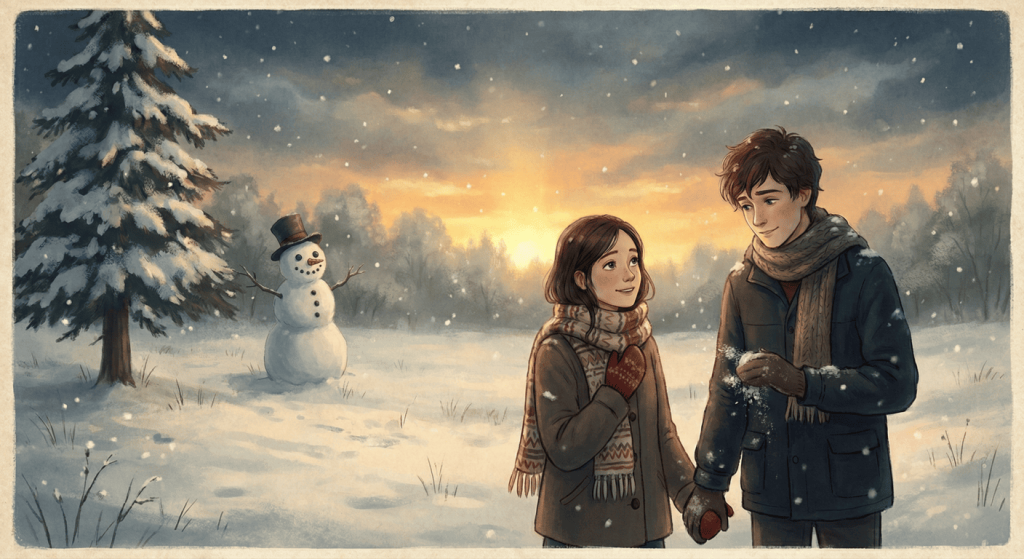
Her name was Clara. His was James. That December, they were not just flirting, they were dreaming. “Later on, we will conspire,” James whispered, half-mocking the familiar lyrics. “As we dream by the fire,” Clara finished, smiling because they both knew exactly what it meant. They had plans, brave and risky, involving slipping away with a borrowed car and getting married before anyone could warn them about being too young or too uncertain.
And they would face it unafraid. Or at least pretend to.
In the meadow that afternoon, after building a snowman, Clara pressed the carrot nose into place while James adjusted the twig arms. “Should we name him?” she asked. James brushed snow from his sleeves. “Your call.”
Clara paused, then grinned. “Parson Brown.”
James burst out laughing. “Clara, that is terrible.”
“It is perfect,” she said. Their parents mentioned the name often enough whenever two teenagers stood talking a little too close. No one actually knew who Parson Brown was. He had become a kind of folklore, the imaginary minister parents invoked to keep teenage hormones in check.
Now he stood as a lopsided snowman with a crooked smile.
James placed a hat on its head. “Does this make things… official?”
Clara wrapped her arms around his neck. “Yes silly, that’s the plan.”
The Snowman Incident
Winter at the North Pole Academy for Elflings brought its usual mix of snowflakes, jingling laughter, and the occasional dramatic mishap. This year’s mishap arrived in the form of a toppled snowman, once the pride of Pip Hollyglint, the academy’s most popular and impeccably styled young elf.
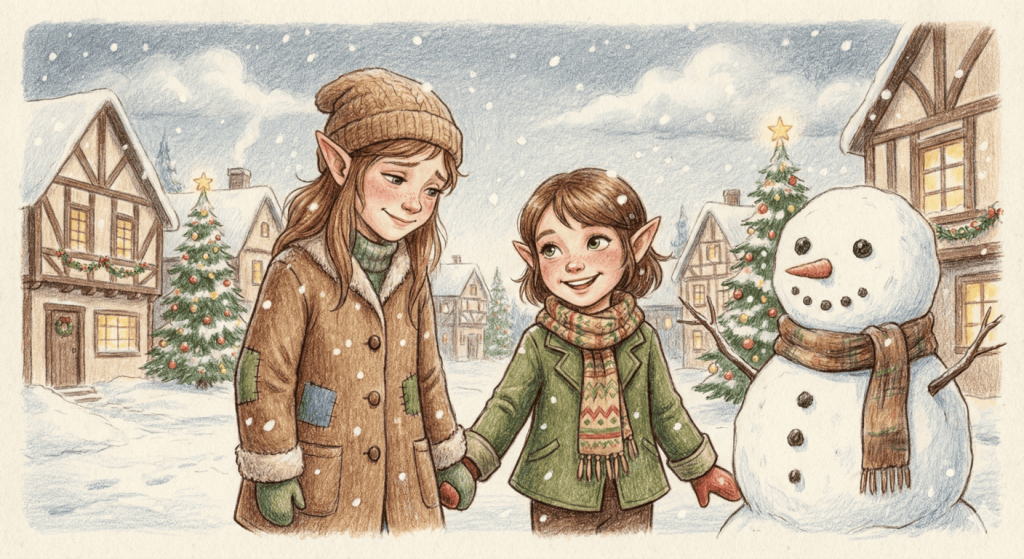
Standing beside the ruined mound was Tivvy Maplewhistle: tall for her age, wrapped in hand-me-down clothes from her many older siblings, and looking thoroughly ashamed.
When Santa arrived to investigate, it didn’t take long for Tivvy to reluctantly admit she had knocked the snowman over. But the reason wasn’t the simple mischief everyone assumed. For some time, Pip had been making sharp little remarks whenever Tivvy walked by. Comments about her height and her “vintage” coat and scarf. Harmless on the surface… except they hadn’t felt harmless to Tivvy. They made her feel small, despite her height.
When Santa turned to Pip for an explanation, she immediately grew defensive. She insisted she was “just joking,” that everyone teased Tivvy about her height, and that she never meant any harm. Santa, in his gentle way, asked if she was certain that “everyone” made those comments. Pip’s head lowered, her cheeks flushing as her defiance wilted.
“I get flustered, okay?” she blurted out.
Santa’s eyes twinkled knowingly, while Tivvy stared, puzzled. “I don’t understand,” Tivvy said softly. “What could possibly flusters you?”
It took Pip a long, trembling moment to gather her courage. “You do,” she admitted at last. “You make my thoughts scramble. I want to say something to make you notice me, but when I try, nonsense spills out. I just… wanted to say something sweet so you’d stop and talk to me.”
Tivvy’s cheeks went nearly as red as Santa’s suit, and Pip looked equally stunned by her own confession.
Seeing the truth settle between them, Santa decided the moment called for gentleness rather than consequence. Instead of punishment, he suggested the two elves rebuild the snowman together.
And so, under a soft, drifting snowfall, the girls began rolling new snowballs and brushing clumps from their mittens. At first the air between them was stiff and awkward. But slowly, Pip found a calmer voice and offered a sincere apology. Tivvy, in a tender moment, admitted that she had always liked Pip, which was why the remarks had stung so much.
“You noticed me?” Pip asked, eyes widening. “You… liked me?”
By the time the new snowman stood proudly, decorated with mismatched buttons from Tivvy’s pocket and a fashionable scarf Pip insisted he “absolutely needed”, the two girls were smiling shyly at each other, the winter night around them warmer than before.
The Great Relay Challenge
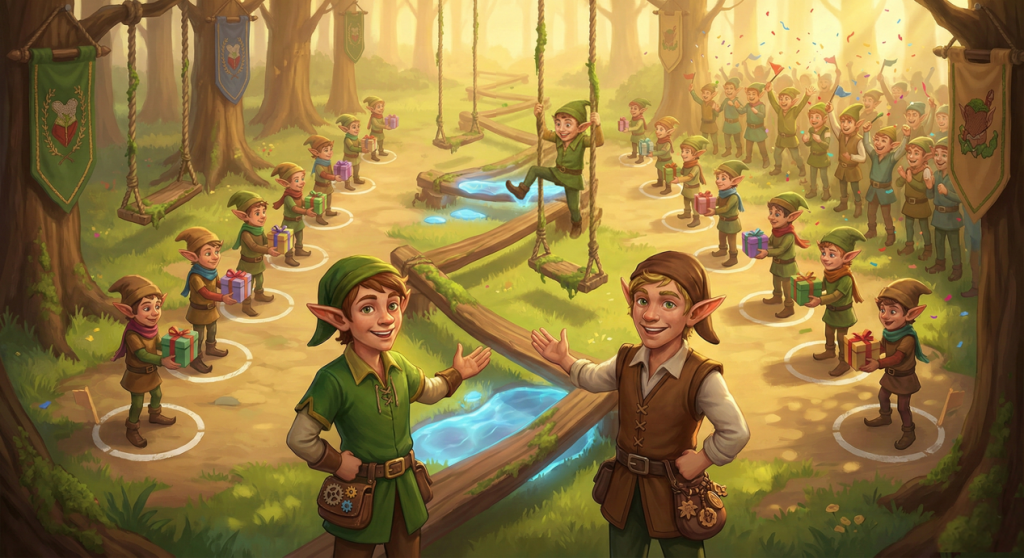
Tinker and Bramble had been best friends since they were three, but today they stood as captains of rival teams in the Great Relay Challenge.
The game was simple: each team had to pass a single gift down a line of 36 elves. If the gift reached the final elf without a dent, that team won. The tricky part was that the line stretched across a 50-meter obstacle course, and each elf could only move within a tiny circle. Only the captains were allowed to run freely along the course, shouting instructions and keeping everyone calm.
Each captain also carried ten small trinkets. If their team got stuck, they could ask the opposing captain for help, offering a few trinkets in exchange. The trinkets factored into the final score, so every decision mattered.
Before the race, the two friends stretched and laughed as if it were training day. Their teams were baffled. “Don’t you want to psych each other out?” someone asked.
Tinker shrugged. “We want to win.” Bramble nodded. “But we don’t need to tear each other down to do it. Competing is what we’re doing today, not who we are.”
The relay began smoothly, both teams staying even through the early obstacles. As the course grew tougher, Tinker excelled at quick-thinking puzzles, while Bramble handled the heavier physical challenges with ease. They warned each other about slippery spots, shouted encouragement, and kept the relay moving.
When Tinker needed help, Bramble refused any payment. Later, Tinker returned the favour without asking for trinkets. Their teams, inspired by the captains, stopped jeering and started cheering both sides.
In the end, Bramble’s team crossed the finish first and Tinker hugged him so proudly that spectators swore he seemed like the true winner.